
Materials-Driven Phototaming of Bacteria Bioelectricity
Friday 24th of July 2026 at 10:30 room R3
Giuseppe Maria Paternò
Department of Physics, Politecnico di Milano, piazza L. Da Vinci 32, 20133 Milano, Italy
Center for Nanoscience and Technology, Istituto Italiano di Tecnologia, via Rubattino 81, 20134 Milano
giuseppemaria.paterno@polimi.it
Keywords. Bacterial bioelectricity; optocapacitance; molecular photoswitches; antimicrobial susceptibility
Engineering living matter requires interfaces that convert external physical cues into native cellular signals. In bacteria, bioelectricity is a powerful control axis because membrane potential (Vm) and the proton motive force couple redox chemistry, ion transport and metabolism to ATP production, transporters, flagellar rotation, motility, dormancy and antibiotic susceptibility.
This presentation treats bacteria as living photovoltaic and electrochemical machines in which photons can be translated into proton gradients, membrane-voltage changes, metabolism and antimicrobial responses. Specifically, we present a optocapacitance; molecular photoswitches; materials-driven route to phototame bacterial bioelectricity by placing photoactive molecules at the membrane. Within an optocapacitive framework, the membrane behaves as a capacitor coupled to surface-potential and ion-conductance pathways; molecular photoswitches can therefore perturb either membrane capacitance or surface potential at the site of action. ZIAPIN2 functions as an intramembrane optomechanical switch that triggers hyperpolarization of bacterial Vm and periodic membrane-potential oscillations in B. subtilis microcolonies [1]. A complementary dipolar switch, MTP2, changes dipole moment upon photoisomerization and exposes context-dependent bioelectrical circuitry through dark homeostatic regulation and light-driven ionic currents [3]. Together, these examples show that bacterial Vm is highly plastic and can be re-weighted by different excited-state pathways. We finally link materials-driven Vm control to bacterial function, demonstrating photomodulation of motility and altered susceptibility to kanamycin [2] with perspectives for persistence, biofilm control and optical mapping of microbial signalling.
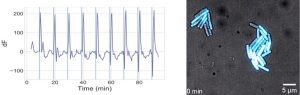
Periodic photo-induced hyperpolarization of a B. subtilis microcolony cultured with the membrane-targeted azobenzene ZIAPIN2 and stimulated by 470 nm light for 10 s every 10 min. Reference: Adv. Sci. 2023, 10, 2205007
[1] T. C. de Souza-Guerreiro, G. Bondelli, I. Grobas, S. Donini, V. Sesti, C. Bertarelli, G. Lanzani, M. Asally, G. M. Paternò, Adv. Sci. 2023, 10, 2205007.
[2] P. Bertolotti, F. Gallinardi, M. Ghidoli, C. Bertarelli, G. Lanzani, G. M. Paternò, Eur. Phys. J. Plus 2025, 140, DOI 10.1140/epjp/s13360-025-06263-7.
[3] A Dipolar Photoswitch Modulates Bacterial Membrane Potential and Reveals Context-dependent Bioelectrical Circuitry, bioRxiv 2026, DOI 10.64898/2026.01.20.700538.